Twenty REASONS WHY ROOT CANALS CAN RUIN YOUR HEALTH
Root canal fillings are a hot topic in dentistry right now because they are so controversial. On the one hand, conventional dentists place over 6 million root candled teeth in patients’ mouth in the UK each year and insist they are perfectly safe. On the other hand, Biological dentists warn that they should come with informed consent due to associated health risks ranging from chronic immune suppression, infections, heart disease to cancer. Who is right? To find out more, please read on …
What is a Root Canal?
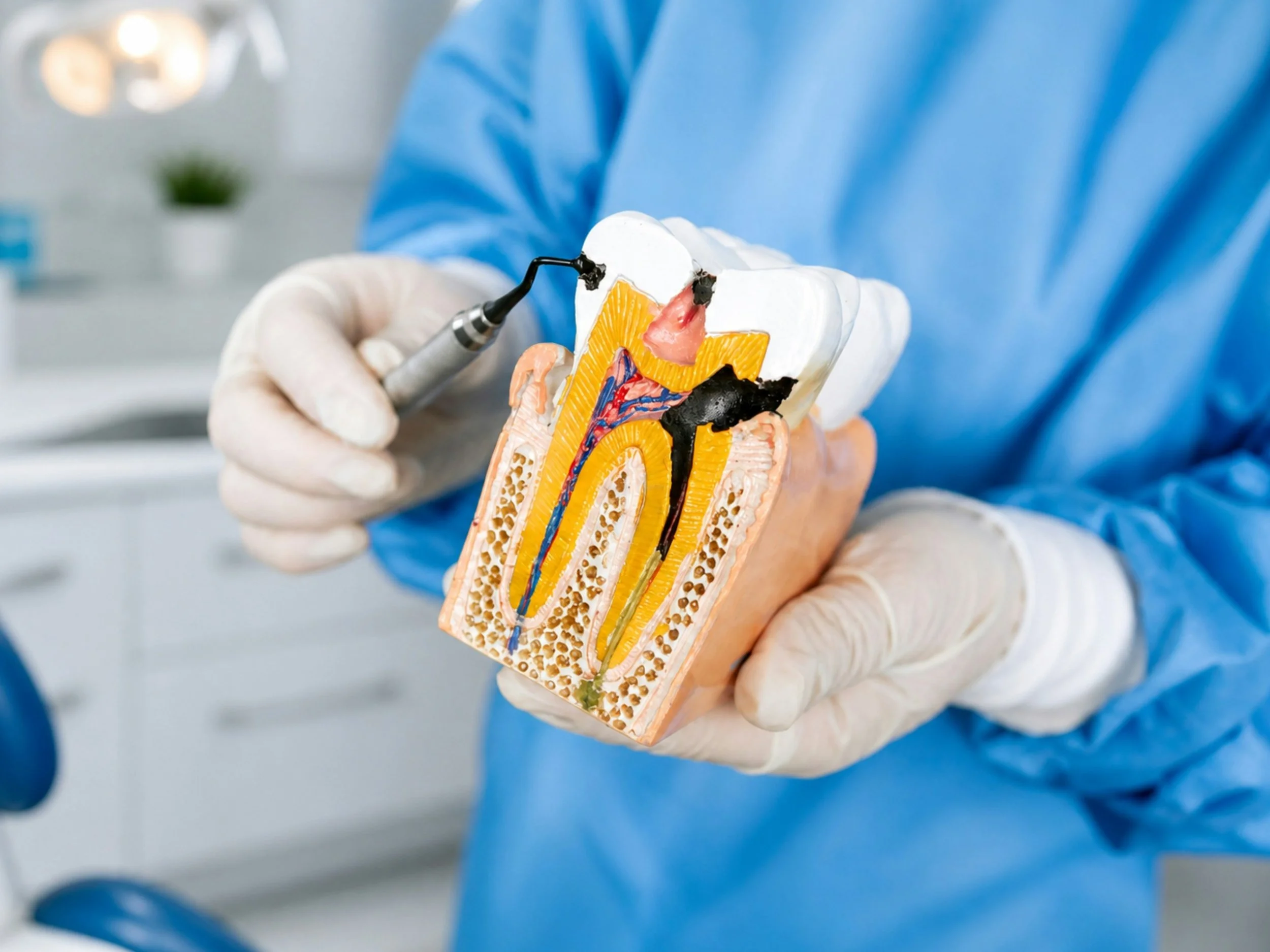
Dentists are taught in dental school to save teeth. Endodontists are specialised dentists dedicated to placing root canal teeth. A Root Canal is a dental procedure designed to save the tooth when the soft tissue inside it, known as the pulp, becomes inflamed, infected or dies. The pulp contains nerves, blood vessels and connective tissue. This can happen as a result of deep decay, a crack or fracture, trauma to the tooth or repeat dental procedures on that tooth.
The dentist removes the pulp tissue from the tooth chamber and narrow canals running down the roots, then cleans and shapes the canals. Once cleaned, dried and shaped, the canals are usually filled with a rubber like material called gutta-percha, together with sealing cement. The opening of the tooth is sealed with a crown.
A root canal is considered successful when the tooth is fully functional without pain or discomfort, and follow-up X-rays confirm that any previous infection in the bone around the root has healed. But is this criteria really reliable? And is there a hidden cost to a patient’s long-term health?
20 Things Your Dentist Won’t Tell You
Let’s examine the case and look at a few root canal facts your regular dentist may not know, especially if he has done no further training or research since dental school:
1.2-D X-rays are commonly used to confirm the success of a root canal by showing no infection round the root tip. Unfortunately, these flat X-rays may miss up to 82% of residual infection! 3D X-rays like CBCT are best placed to spot infections. 2D X-rays are not enough.
2.Root canal teeth are dead teeth and infections in them produce no symptoms!
3.The complex structure of a tooth and its canals means that no dentist, with all the will in the world, can decontaminate that tooth from infection. Not even with a laser. An average tooth contains around 3 kilometres of microtubules. Therefore, millions of bacteria can be left inside the tooth after treatment. The only safe way of getting rid of an infection in a root canal is extraction.
4.A root canal is a dead tooth with no blood supply. Therefore antibiotics, antimicrobials, herbal medicines, vitamins and minerals are not going to be able to enter the tooth. Neither can your white blood cell immune army get in because white blood cells are about 20 times bigger than the tiny openings in teeth.
5.A root canal is therefore the ideal home and breeding ground for pathogens which can flourish and prosper undisturbed by the immune system. The older the root canal, the more pathogens you would expect it to harbour.
6.The pathogens in root canals pee and poop and produced their own toxic wastes. Two of these are called thioethers and mercaptans. They are known cancer promoters, being extremely toxic to the body.
7.The pathogens and toxins that live inside root canals can leak out when the host bites down on the tooth. They can enter the periodontal ligament which attaches the tooth to the bone (another great breeding ground) or travel to distant organs via the lymph and bloodstream. The tooth thus acts as a toxic pump.
8.Focal infection is the name given to local infections which can then affect distant body parts.
9.The immune system can release pro-inflammatory substances in response to an infected and toxic root canal tooth. We can look for these on standard blood tests (TNF alpha, Il01B, TNF beta, Rantes). Rantes is a known promotor of metastases in cancers. Elevated TNF beta is associated with increased risk of post menopausal breast cancer.
10.A root canal is a dead organ. Dentists are the only medical professionals allowed to leave a dead organ in the body. If we remove a dead organ in one part of the body i.e. a gangrenous toe, why are we allowed to leave it in another part?
11.In the 1920s, the then President of the American Dental Association, Dr Weston A. Price, conducted hundreds of experiments where he extracted root candled teeth from patients and implanted them under the skin of rabbits. The patients would recover from their chronic illness and the rabbits would sicken of the same illness as the patients and then die. Due to the strength of this research, root canals were abandoned as a dental practice at the time. A certain group of dentists later discounted Dr Price’s work as “unscientific” and the root canal industry was reborn.
12.Due to modern scientific methods and PCR analysis, the validity of Dr Price’s root canal research has now been fully proven. A good account of this research is the book Root Canal Cover-Up by root canal specialist Dr George Meinig.
13.Apical periodontitis (AP) is a particular problem that can arise with a root filling. It is estimated that there are 61% of patients with root filled teeth that may develop apical periodontitis. AP is associated with cardiovascular disease, diabetes and other systemic inflammatory diseases.
14.Bacteria in root canal teeth organise themselves in biofilms, a sort of protective matrix. This makes the organisms much more resistant to immune cells and antibiotics. In order to dissolve the biofilms, it can take weeks or months. A root canal treatment lasts around an hour to 90 minutes and has no chance of killing all the bacteria.
15.Root canals have been found to harbour a wide variety of germs including bacteria like P. gingivalis (linked to Alzheimer’s), Lyme, Bartonella, strep etc. fungi and mould like Candida, methane producing bacteria such as those involved in SIBO, viruses like Epstein-Barr, Cytomegalovirus and Sars Cov 2.
16.To assess the amount of toxicity in a root canal tooth, a dentist can do a simple chairside test known as the OroTox test.
17.Blood clots analysed from patients who died of heart attacks showed 78% of blood clots showed the same DNA as that in root fillings. Oral bacteria is a well known driver for coronary events.
18.If someone has two or more root fillings, they are 62% more likely to have coronary heart disease. 99% of dentists are not aware of this.
19.Gum disease (periodontitis) is recognised as being associated with cardiovascular disease. Bacteria entering the blood stream, including P. gingivalis, can damage the lining of blood vessels. Chronic inflammation then contributes to the development of arterial plaques. Some oral bacteria and their products contribute to the development of platelet activation and inflammation. If this is so well known for bacteria in gum disease, why isn’t it recognised for the same bacteria that live in root canals and escape from them?
20.The gutta-percha root canal filling material is not pure gutta-percha. It is 20-27% gutta-percha (rubber-like material), 60-66% zinc oxide toxic to cells), 8-13% heavy metals (could be mercury, lead, barium sulphate etc.), around 3% waxes/resins (chloroform, Bisphenol A, formaldehyde, cresol (damage living tissues)etc. and a small amount of colouring agent. These toxic chemicals can leak into the periodontal ligament and surrounding tissues.
The scary reality is that 99% of dentists in the UK will not be aware of the above. That makes going to dentists who are aware of the above root filling information (known as Biological dentists) the only safe option to safeguard your health.
The take-home message is that Biological dentistry recognises that dentistry does not stop at the neck but is a whole body matter. Root canals are always infected as the procedure itself is flawed. The root canal procedure should follow full informed consent. For example, if your dentist told you that by having root canal, you substantially increase your risk of heart disease, would you still go ahead?
When asked what was the best answer to the problem of widespread dental ignorance, Dr James Howensteine MD wrote in 2005, “I think the answer is to stop having a relationship with uninformed dentists. You must seek a biologic trained dentist even if it means traveling a longer distance to get dental care. As dentists see their patient loads dwindling they will begin to attend seminars where they can be brought up to snuff about truthful modern scientific dentistry. Remember, if you continue dental care with an ignorant dentist, your body will suffer from his or her mistakes.”
I belong to the group of hundreds of patients who have had their root fillings safely removed and experienced health improvement because of it. The right nutritional and biological support is important before safe removal with a Biological dentist and that is what I provide for my patients in the Good Health Clinic.
If you would like help with any of the above issues, please get in touch with the Good Health Clinic on goodhealthclinic@outlook.com to request a free 30 minute Enquiry Call or book an appointment. Please note that an Enquiry call is not a consultation but an exploratory call to see if this is a clinical approach you wish to pursue.To your very good health,
Suzanne Jeffery (Nutritional Medicine Consultant)
M.A.(Oxon), BSc.(NMed), PGCE, GNC, BSEM, MNNA, CNHC
The Good Health Clinic at The Business Centre, 2, Cattedown Road, Plymouth PL4 0EG
Tel no: 07836 552936/ Answer phone: 01752 774755
Disclaimer:
All advice given out by Suzanne Jeffery and the Good Health Clinic is for general guidance and informational purposes only. All advice relating to other health professionals’ advice is for general guidance and information purposes only. Readers are encouraged to confirm the information provided with other sources. Patients and consumers should review the information carefully with their professional health care provider. The information is not intended to replace medical advice offered by other practitioners and physicians. Suzanne Jeffery and the Good Health Clinic will not be liable for any direct, indirect, consequential, special, exemplary or other damages arising therefrom.